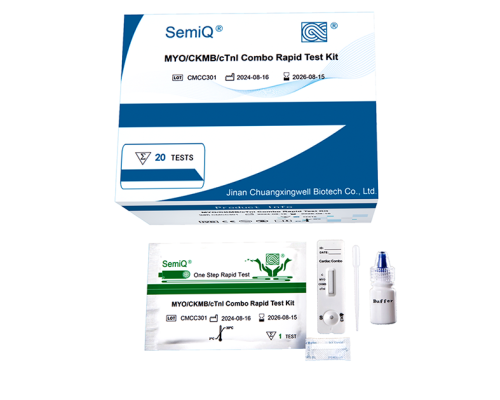
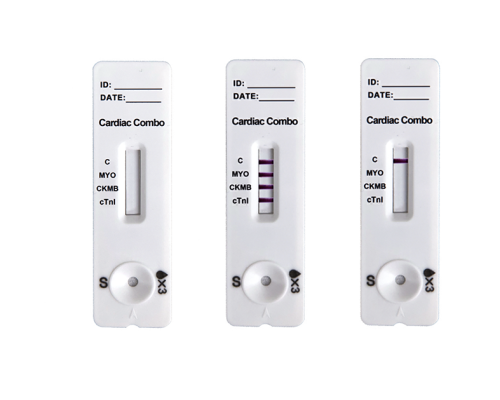
Myoglobin (MYO), Creatine Kinase MB (CK-MB) and cardiac Troponin I (cTnI) are three specific protein marker found in cardiac muscle. They are proteins released into the bloodstream after cardiac injury.
Myoglobin (MYO) is a heme-protein normally found in skeletal and cardiac muscle. It is responsible with transporting oxygen within the muscle cells. When muscle cells are damaged; Myoglobin is released into the blood rapidly due to its relatively small size. The level of Myoglobin increases measurably above baseline within 2-4 hours post-infarct, peaking at 9-12 hours, and returning to baseline within 24-36 hours. A number of reports suggest the measurement of Myoglobin as a diagnostic aid in confirming the absence of myocardial infarction with negative predictive values of up to 100% reported at certain time periods after onset of symptoms. Therefore, myoglobin has been advocated as a sensitive marker for early acute myocardi al injury by American College of Cardiology Committee.
Creatine Kinase is a type of enzyme that can be found mostly in skeletal muscle, cardiac muscle (myocardium) and the brain with a molecular weight of 87.0 kDa. Creatine Kinase is a dimeric molecule formed from t two monomer subunits, CK-M(for skeletal muscle derived)and CK-B (for brain derived) which combine to form three different isoenzymes, CK-MM, CK-BB, and CK-MB. BB is found primarily in the brain. Skeletal muscles primarily contain the MM isoform, with trace amount of MB(around 1-4% of total CK activity). Cardiac muscles also contain the MM isoform, but higher amount of MB, typically around 20% of total CK activity. CK-MB is the isoenzyme of Creatine Kinase most involved in the metabolism of cardiac muscle tissue. The release of CK-MB into the blood following MI can be detected within 3-8 hours after the onset of symptoms. It peaks within 9 to 30 hours, and returns to baseline levels within 48 to 72 hours. CK-MB is one of the most important cardiac markers and is widely recognized as the traditional marker for the diagnosis of MI.
Cardiac Troponin I is a protein found in cardiac muscle, with a molecular weight of 22.5 kDa. The troponin complex consists of three subunits, troponin T (TnT), troponin I (TnI), and troponin C (TnC). Each subunit has a distinct function . cTnI contains an additional N-terminal sequence and is highly specific for myocardium. Due to the high myocardial specificity and the long duration of elevation, cTnI has become an important marker in the diagnosis and evaluation of patients suspected of having an acute myocardial infarction (AMI). Clinical studies have demonstrated the release of cTnl into the blood stream within hours following acute myocardia infarctions(AMl)or ischemic damage. Elevated levels of cTn are detectable in blood within 4 to 6 hours after the onset of chest pain, reaching peak concentrations in approximately 8 to 28 hours, and remain elevated for 3 to 10 days following AM.
 Follow Official Account